

After I read a few of the letters on Genesis aloud to him, our 12-year-old son asked if he could take @eastbrad’s Letters to a Future Saint with him to read in bed. Which I happily allowed. :) It’s the introduction to the Christian faith that I wish someone had given me as a young adult. 📚
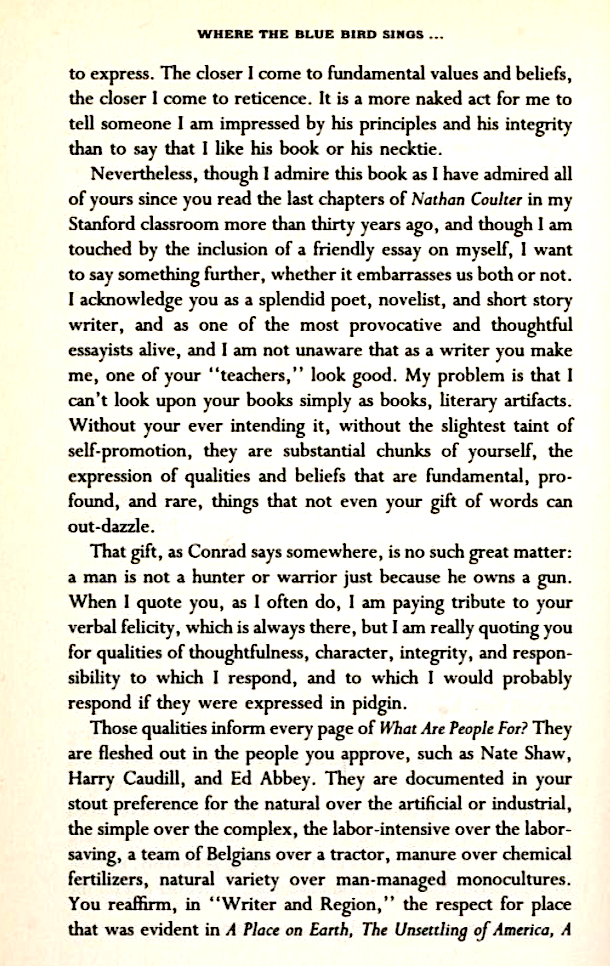
Wallace Stegner’s 1990 open letter to Wendell Berry is the best description of Berry’s character and work that I’ve read, even among the many tributes.
“We can only solve the problem of time through sanctification of time. To men alone time is elusive; to men with God time is eternity in disguise.” Abraham Heschel, The Sabbath, 101. 📚
“Judaism tries to foster the vision of life as a pilgrimage to the seventh day; the longing for the Sabbath all days of the week which is a form of longing for the eternal Sabbath all the days of our lives.” Abraham Heschel, The Sabbath, 90-91 📚
As we’ve been house hunting this spring, I’ve put together a Pattern Language House Scorecard to help evaluate prospective houses based on the most relevant patterns in A Pattern Language. It’s highly unique to us: I’ve selected patterns that I think matter the most to us (describing them in terms I can easily remember/understand) and tried to weight them according to their importance for us. Interestingly, most of the houses we’ve looked at have fallen into a fairly narrow range of percentages (around 50%), which may be an issue with the selection/weighting?
“If our lives do not somehow witness to the truth, somehow reflect and attest the truth in our own limited ways, students will not find us credible, no matter how impressive our theological reasoning happens to be. In the classroom, we are never not teaching. Everything we say and do (and do not do) communicates something to students. An unguarded and revealing casual aside can falsify an entire lecture, indeed an entire semester. . . .[Y]our life is your final answer to the question of who you think God is. And there is no good reason to hope students will be persuaded by what you say if, when they examine your life, they conclude that you do not believe what you say.” -Adam Neder, Theology as a Way of Life, 73. 📚
For Schumacher, “Small is Beautiful” only when in the right proportion/relationship to the large: “What I wish to emphasize is the duality of the human requirement when it comes to the question of size: there is no single answer. For his different purposes man needs many different structures, both small ones and large ones, some exclusive and some comprehensive. . . . [W]hat is needed in all these matters is to discriminate, to get things sorted out. For every activity there is a certain appropriate scale . . .” (70)
Schumacher felt the need to emphasize the small scale only because of a contemporary “idolatry of giantism” that needed correction and balance, not because of the innate superiority of the small for all things.
Schumacher on Scientific and Humanistic Education
“Science and engineering produce ‘know-how’; but ‘know-how’ is nothing by itself; it is a means without an end, a mere potentiality, an unfinished sentence. ‘Know-how’ is no more a culture than a piano is music. Can education help us finish the sentence, to turn potentiality into a reality to the benefit of man?
To do so, the task of education would be, first and foremost, the transmission of ideas of value, of what to do with our lives. There is no doubt also the need to transmit know-how but this must take second place, for it is obviously somewhat foolhardy to put great powers into the hands of people without making sure that they have a reasonable idea of what to do with them. At present, there can be little doubt that the whole of mankind is in mortal danger, not because we are short of scientific and technological know-how, but because we tend to use it destructively, without wisdom. More education can help us only if it produces more wisdom.” E. F. Schumacher, Small Is Beautiful, 86.
“The modern economy is propelled by a frenzy of greed and indulges in an orgy of envy, and these are not accidental features but the very causes of its expansionist success. The question is whether such causes can be effective for long or whether they carry within themselves the seeds of destruction. . . . If human vices such as greed and envy are systematically cultivated, the inevitable result is nothing less than the collapse of intelligence. A man driven by greed or envy loses the power of seeing things as they really are, of seeing things in their roundness and wholeness, and his very successes become failures. If whole societies become infected by these vices, they may indeed achieve astonishing things but they become increasingly incapable of solving the most elementary problems of everyday existence.” E. F. Schumacher, Small is Beautiful 📚
Charisma as a kind of “influence from below,” that requires listening carefully to and selecting for what resonates with the audience/constituency:
“This particular form of influence from below works only in certain conditions. . . . A social or revolutionary movement not yet in power is more likely to have better hearing than one that has come to power. The most powerful don’t have to learn how to carry a tune. Or, as Kenneth Boulding put it, ‘the larger and more authoritarian an organization [or state], the better chance that its top decision-makers will be operating in purely imaginative worlds.'” James C. Scott, Two Cheers for Anarchism, p. 29.
“You cannot spill one drop of American blood without spilling the blood of the whole world. We are not a narrow tribe of men . . . our blood is as the flood of the Amazon, made up of a thousand noble currents all pouring into one. We are not so much a nation as a world.” Hermann Melville, Redburn
“What prepares men for totalitarian domination in the non-totalitarian world is the fact that loneliness, once a borderline experience usually suffered in certain marginal social conditions like old age, has become an everyday experience of the evergrowing masses of our century.” Hannah Arendt, The Origins of Totalitarianism 📚

He makes wars cease to the ends of the earth;
he breaks the bow and shatters the spear;
he burns the chariots with fire.
“Be still, and know that I am God.
I will be exalted among the nations,
I will be exalted in the earth!”
-Psalm 46
Living in the Twin Cities, and feeling the need to monitor The Situation daily––not to mention keep abreast of our hyper-local neighborhood chat (~100 neighbors in an area of 16 city blocks)—which puts all personal rules about online news and smartphone usage in shambles, I’m having to be even more intentional in seeking out sources beyond the noise to try to make sense of things. Here’s what I’ve turned to in the last week or so:
-the Psalms (for obvious reasons)
-Hannah Arendt, The Origins of Totalitarianism (the final section on the anatomy of totalitarianisms)
-MLK Jr’s Letter from Birmingham Jail (what is principled opposition to authority?)
-@ayjay’s writings on anarchism (what are the possibilities opened up by organizing with neighbors?)
-Zena Hitz’s Lost in Thought (what ultimate ends do politics enable anyway?)
“If intellectual life is not left to rest in its splendid uselessness, it will never bear its practical fruit. Likewise, the struggle for a just society is worthless if it costs us the fruit of justice.” Zena Hitz, Lost in Thought
Coleridge, on the function of poetry (specifically Wordsworth’s task in his contributions to Lyrical Ballads): “awakening the mind’s attention from the lethargy of custom, and directing it to the loveliness and wonders of the world before us.” Biographia Literaria, ch. 14
More from Lewis on attention: “For what you see and hear depends a good deal on where you are standing: it also depends on what sort of person you are.” (The Magician’s Nephew)